Core Web Vitals in 2026: Why Page Speed Now Decides Who Ranks

For years, many businesses treated website speed as a secondary consideration. The prevailing assumption was simple: content is king. If a website had strong content, authoritative backlinks, and solid on-page SEO, being slightly slow was often considered a problem that could be tolerated.
That assumption is becoming increasingly difficult to defend.
Website performance has steadily moved from being a technical consideration to an important part of the broader search experience. And as Google's search systems continue to place greater emphasis on how users experience websites, businesses that have relied on content quality alone are facing a more demanding SEO environment.
In 2026, having great content is still essential. But increasingly, how quickly and smoothly users can access and interact with that content matters too.
What Are Core Web Vitals?
Core Web Vitals are three specific performance metrics that Google uses to evaluate real-world user experience. Rather than relying exclusively on controlled laboratory tests, Google collects this information from actual visitors using Chrome through its field data systems.
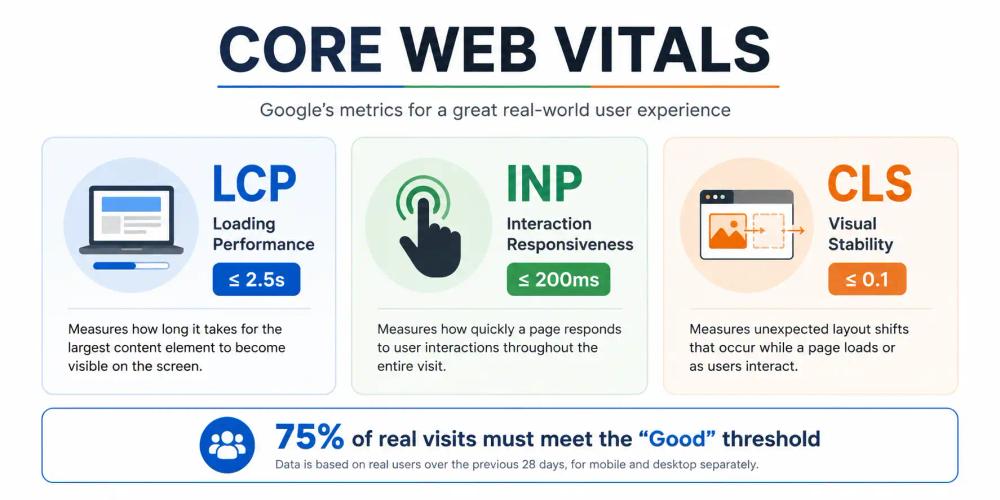
According to Google's own documentation on web.dev, the three Core Web Vitals are:
1. Largest Contentful Paint (LCP)
Largest Contentful Paint (LCP) measures loading performance. More specifically, it measures how long it takes for the largest visible piece of content on a page to render.
This is commonly a hero image, prominent heading, banner, or other large element near the top of the page.
Google currently considers an LCP of 2.5 seconds or less to be good.
The important distinction is that LCP isn't simply asking, "How quickly did the page load?" It is asking whether the primary content a visitor needs to see becomes available quickly enough.
2. Interaction to Next Paint (INP)
Interaction to Next Paint (INP) measures how responsive a website is when users interact with it.
Rather than measuring just one interaction, INP considers interactions throughout a user's visit and evaluates how quickly the page responds visually after those interactions.
The current good threshold is 200 milliseconds or less.
INP replaced First Input Delay (FID) in March 2024. It is a more comprehensive measure because it considers the responsiveness of interactions throughout the user's session rather than focusing primarily on an initial interaction.
For websites that rely heavily on JavaScript, complex forms, filters, menus, calculators, dashboards, or other interactive components, INP can be particularly important.
3. Cumulative Layout Shift (CLS)
Cumulative Layout Shift (CLS) measures visual stability.
It tracks how much visible content unexpectedly moves while a page is loading or while a visitor is interacting with it.
A common example is clicking a button only for the page to shift at the last moment because an image, advertisement, font, or dynamically loaded component has suddenly appeared.
Google considers a CLS score of 0.1 or less to be good.
You need to pass all three
Core Web Vitals are evaluated using real-world visitor data. A website needs at least 75 percent of visits to meet the good threshold for each metric to pass that metric.
The evaluation is also separated between mobile and desktop.
That means having excellent LCP and CLS does not compensate for poor INP. If one metric consistently fails to meet the required threshold, the page does not achieve a good overall Core Web Vitals result.
Google explains the methodology behind these thresholds in its documentation on how Core Web Vitals thresholds are defined.
What Actually Changed in 2026?
There has been plenty of speculation around Core Web Vitals this year, so it is important to separate confirmed developments from SEO industry commentary.
One claim that has circulated is that Google reduced the "good" LCP threshold from 2.5 seconds to 2.0 seconds in 2026.
That claim does not align with Google's current documentation, which continues to list 2.5 seconds as the good LCP threshold.
This distinction matters. SEO advice spreads quickly, and technical claims can easily become accepted as fact simply because they are repeated often enough. Before changing a development roadmap or investing heavily in a technical overhaul, businesses should verify important performance claims against Google's primary documentation.
The bigger story in 2026 is not necessarily a dramatic change to the numbers themselves. It is the continued evolution of how website performance fits into the wider search ecosystem.
Recent analysis following Google's March 2026 core update has placed renewed attention on the relationship between performance and search visibility. Pages with strong content still need to satisfy the fundamental requirements of relevance, usefulness, authority, and search intent. But when competing pages offer similarly strong content, user experience and technical performance can become increasingly important differentiators.
In other words, performance isn't replacing content. It is becoming an increasingly important complement to it.
There have also been developments around how real-world interaction performance is measured. According to WebVitals.tools, changes to the measurement of INP and improvements in how single-page applications are represented in Chrome UX Report data make it even more important for developers to assess performance using current field data.
A site that previously appeared borderline may therefore benefit from being tested again using current measurement methods.
A new signal to watch
Another development attracting attention is the emergence of a broader approach to visual stability.
Google introduced a Visual Stability Index in early 2026, extending the concept of visual stability beyond the initial loading experience measured by CLS and looking more broadly at stability throughout a browsing session, including scrolling.
It is important to distinguish between an emerging metric and a confirmed Google ranking factor. The Visual Stability Index is not currently established as a confirmed ranking signal.
However, its direction is worth watching. Google has historically evolved its user-experience metrics over time, and broader measurements of how stable and usable a page remains during an entire session could become increasingly relevant.
Techvedhas provides additional discussion of this development and its potential implications.
Why Core Web Vitals Matter Beyond SEO
The business case for improving website performance goes well beyond Google rankings.

A slow website creates friction.
Every additional second a visitor waits for a page, product, form, checkout process, or interactive feature increases the opportunity for that visitor to abandon the experience.
Research frequently cited in the digital marketing industry has linked increases in page-load time with declines in conversion rates. Even a relatively small performance improvement can therefore have a meaningful commercial impact for websites generating substantial traffic and transactions.
The mobile experience makes this even more important.
More than 64 percent of global web traffic now comes from mobile devices, meaning businesses cannot assume that visitors are accessing their websites using fast desktop computers and reliable broadband connections.
Mobile users may be dealing with slower networks, less powerful processors, limited bandwidth, or less predictable connectivity.
A website that feels reasonably fast in a developer's office can therefore behave very differently on a real mobile device in the hands of a customer.
And despite Core Web Vitals being part of the SEO conversation for several years, performance remains a problem across a significant portion of the web.
Chrome UX Report data cited by Fog Digital Marketing indicates that roughly 28 percent of websites continue to struggle with the INP responsiveness metric alone.
The lesson is straightforward:
Website performance is not merely a technical exercise. It is a customer-experience and revenue issue.
Where Should You Focus First?
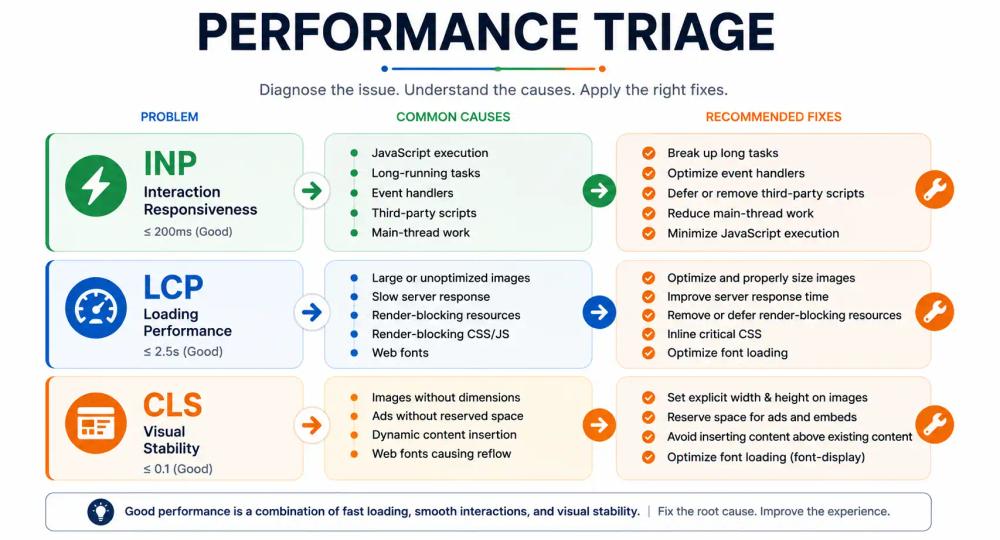
Not every performance problem requires the same solution. The most effective approach is to identify which Core Web Vital is actually failing and then address the underlying cause.
Improving INP
For many modern websites, INP is the most technically challenging metric to improve.
The problem is often excessive JavaScript execution.
Large JavaScript bundles, inefficient event handlers, unnecessary third-party scripts, analytics tools, chat widgets, advertising scripts, and other interactive components can compete for the browser's main thread.
Common improvements include:
- Breaking long-running JavaScript tasks into smaller chunks.
- Reducing unnecessary JavaScript execution.
- Removing expensive synchronous operations from the interaction path.
- Optimising event handlers.
- Deferring non-critical scripts.
- Auditing third-party scripts.
- Removing unnecessary plugins and functionality.
- Reducing the amount of JavaScript required to make a page interactive.
For WordPress websites in particular, this can require looking beyond basic caching and image optimisation. A website can have excellent caching and still suffer from poor INP because its plugins, themes, tracking scripts, or page-builder components are demanding too much from the browser.
Improving LCP
LCP is primarily about getting the most important visible content onto the screen quickly.
Typical improvements include:
- Compressing and properly sizing images.
- Serving modern image formats where appropriate.
- Preloading critical assets.
- Prioritising the LCP element.
- Reducing render-blocking CSS and JavaScript.
- Improving server response times.
- Using an effective caching strategy.
- Optimising fonts.
- Removing unnecessary resources from the initial page load.
For many websites, the hero section is the first place to investigate.
If the largest element above the fold is a 2MB background image that is loaded inefficiently, no amount of excellent copywriting will make the initial experience feel fast.
Improving CLS
CLS is often the most straightforward of the three metrics to address.
The goal is to prevent content from unexpectedly moving around.
Common fixes include:
- Defining explicit dimensions for images.
- Reserving space for advertisements.
- Reserving space for dynamically loaded components.
- Avoiding unexpected insertion of content above existing content.
- Optimising web-font loading.
- Ensuring embedded media has reserved dimensions.
- Reviewing animations and transitions that cause layout movement.
A visitor should not have to chase a button because an image suddenly loaded above it.
That is exactly the kind of experience CLS is designed to identify.
Measure Real Users, Not Just Your Development Laptop
One of the biggest mistakes businesses make when assessing website performance is relying on a single Lighthouse or PageSpeed Insights laboratory test.
Lab testing is valuable. It helps developers reproduce problems and diagnose specific technical issues.
But it does not represent every real visitor.
A website can score well in a controlled test while performing poorly for users on slower mobile devices, different networks, or less powerful hardware.
That is why field data matters.
Google's Core Web Vitals assessment relies heavily on real-world data collected from actual users. Businesses should therefore monitor performance through tools such as Google Search Console's Core Web Vitals report and the Chrome User Experience Report (CrUX).
The objective should not be to achieve an impressive laboratory score simply for the sake of seeing a green number.
The objective is to make the website consistently fast, responsive, and stable for real customers.
The Bigger Picture
Core Web Vitals are no longer something businesses can comfortably treat as a technical checklist buried somewhere in the SEO strategy.

They are part of a much broader shift in how websites are evaluated.
Search engines want to deliver useful results. Users want websites that provide those answers quickly and without friction. Businesses want visitors to stay, engage, enquire, subscribe, or buy.
Those objectives increasingly overlap.
Strong content remains fundamental. Backlinks remain valuable. Search intent, topical authority, technical SEO, structured data, accessibility, and countless other factors still matter.
But a website that makes users wait, freezes when they interact with it, or shifts content underneath their fingers is creating unnecessary friction at precisely the point where a potential customer is trying to engage.
The takeaway for businesses is simple:
Don't treat website performance as an afterthought.
If you are investing in SEO, content marketing, paid traffic, or a new website, performance should be considered part of the strategy from the beginning, not something to fix after everything else has been built.
In 2026 and beyond, the competitive advantage will increasingly belong to websites that don't just have something valuable to say, but deliver that value quickly, smoothly, and reliably.


Ready to transform your business?
Let's discuss how our expert Web Development solutions can drive measurable growth for your organization.
Schedule a Consultation