Why Your Website Is a Revenue Engine, Not a Digital Brochure

For a long time, businesses treated their websites like digital business cards. You hired a designer, built a static page on a legacy platform, uploaded basic service lists, and let it sit online for three to five years before touching it again.
That playbook is obsolete.
In today's fast-paced digital market, your web platform is often the single most critical touchpoint in your sales pipeline. Buyers are more impatient, security threats are more sophisticated, and search engines penalize slow, bloated websites. If your platform takes three seconds longer to load than a competitor's, or presents a clunky mobile interface, prospective clients will bounce before they ever read your value proposition.
Modern web development isn't just about crafting clean visual designs, it is about engineering high-performance digital platforms that deliver sub-second speeds, rock-solid security, and clear conversion paths.
The Four Architecture Pillars of High-Performance Web Platforms
To convert traffic into measurable business growth, modern web architecture relies on four foundational pillars:
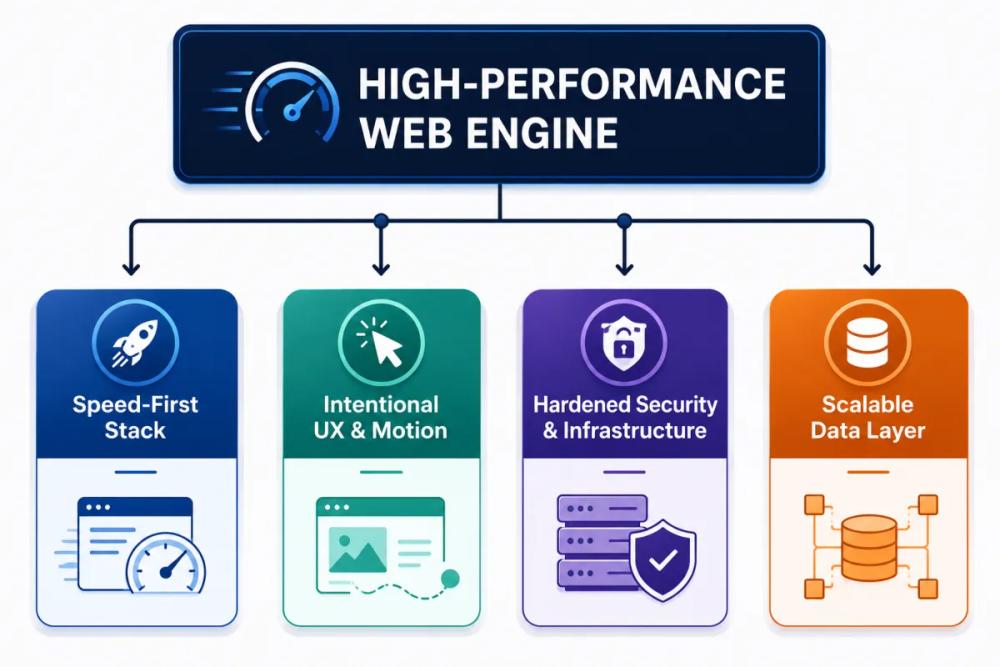
1. The Speed-First Modern Tech Stack
Legacy monolithic Content Management Systems (CMS) often bundle database queries, template rendering, and plugin logic into every single page request. This creates bloated code bases, server lag, and frequent performance drops.
Modern web development leverages decoupled or hybrid architectures using modern frameworks like Next.js, Astro, or Tailwind CSS, coupled with Headless CMS platforms (e.g., Sanity, Strapi). This architecture yields several immediate advantages:
- Pre-rendered Pages: Delivering static HTML via Global Content Delivery Networks (CDNs) for lightning-fast delivery.
- Dynamic API Hydration: Fetching live interactive elements without blocking page rendering.
- Clean Code Distribution: Sending only necessary JavaScript to the user's browser, radically reducing page payload size.
2. Intentional UX/UI & Micro-Interactions
Visual aesthetics matter, but performance-driven user experience (UX) matters more. Modern web applications utilize micro-interactions and smooth UI animations (powered by tools like GSAP or Framer Motion) to guide user intent rather than clutter screen real estate.
- Purposeful Motion: Micro-animations should direct focus to primary Calls-to-Action (CTAs) and confirm user actions.
- Cognitive Simplicity: Interfaces must minimize visual friction, letting visitors absorb information quickly and navigate toward conversion points effortlessly.
3. Hardened Infrastructure & Security Hardening
A high-converting platform is useless if it is vulnerable to malicious attacks, spam exploits, or downtime. Web development must incorporate security hardening directly at the infrastructure level:
- DNS and Server-Level Hardening: Utilizing cloud networks (such as Cloudflare) to mitigate DDoS attacks and enforce modern SSL/TLS protocols.
- Email & Domain Authentication: Correctly configuring DMARC, DKIM, and SPF protocols to preserve domain reputation and guarantee transactional emails land in customer inboxes.
- Decoupled Architecture Defense: Decoupling the front-end user experience from the back-end database significantly shrinks your attack surface compared to legacy monolithic setups.
4. Privacy-First, Scalable Data Analytics Architecture
A modern website must be an active learning feedback loop. By integrating first-party data collection and analytics frameworks safely, businesses can track real-time user journeys, run A/B conversion tests, and adapt content strategies based on verified user behaviour rather than guesswork.
Architectural Comparison: Legacy Monolith vs. Modern Web Stack
| Metric / Feature | Legacy Monolithic Architecture | Modern Decoupled Stack (Next.js / Astro / Headless) |
|---|---|---|
| Average Load Times | 2.5s - 5.0s+ (Heavy server rendering) | 0.3s - 1.2s (Pre-rendered edge distribution) |
| Security Risk Profile | High attack surface (Plugins, database exposure) | Low attack surface (Static endpoints & API keys) |
| Mobile Responsiveness | Often slow with layout shifts | Optimized for Core Web Vitals out-of-the-box |
| Scalability | Requires scaling central web servers | Scales infinitely across global edge networks |
| Content Operations | Locked inside complex CMS themes | Flexible Headless CMS feedable to multiple channels |
Transforming Your Web Platform into a High-Converting Engine
If your current web infrastructure feels slow, fragile, or outdated, follow this technical blueprint to rebuild for modern performance:
- Audit Core Web Vitals: Run performance diagnostics using tools like Google PageSpeed Insights. Focus on Largest Contentful Paint (LCP), Interaction to Next Paint (INP), and Cumulative Layout Shift (CLS).
- Decouple Frontend and Backend: Move away from plugin-heavy, single-server setups. Transition to a modern, component-driven framework that separates your design presentation layer from your content storage.
- Optimize User Journeys: Map out clear user conversion paths. Every single page should have a clear purpose, a strong headline, concise copy, and an accessible call to action.
- Implement Continuous Deployment: Utilize modern Git-based hosting pipelines (e.g., Vercel, Netlify) so that every code update, security patch, and content tweak is instantly built, tested, and deployed securely.
Speed, Security, and Strategy Drive Digital Growth
A modern, high-performance website is one of the highest-leverage investments an organization can make. By pairing cutting-edge front-end technologies with purposeful UX and enterprise-grade security, you transform your web platform from a passive online brochure into an active revenue engine built to outperform the competition.


Ready to transform your business?
Let's discuss how our expert Web Development solutions can drive measurable growth for your organization.
Schedule a Consultation